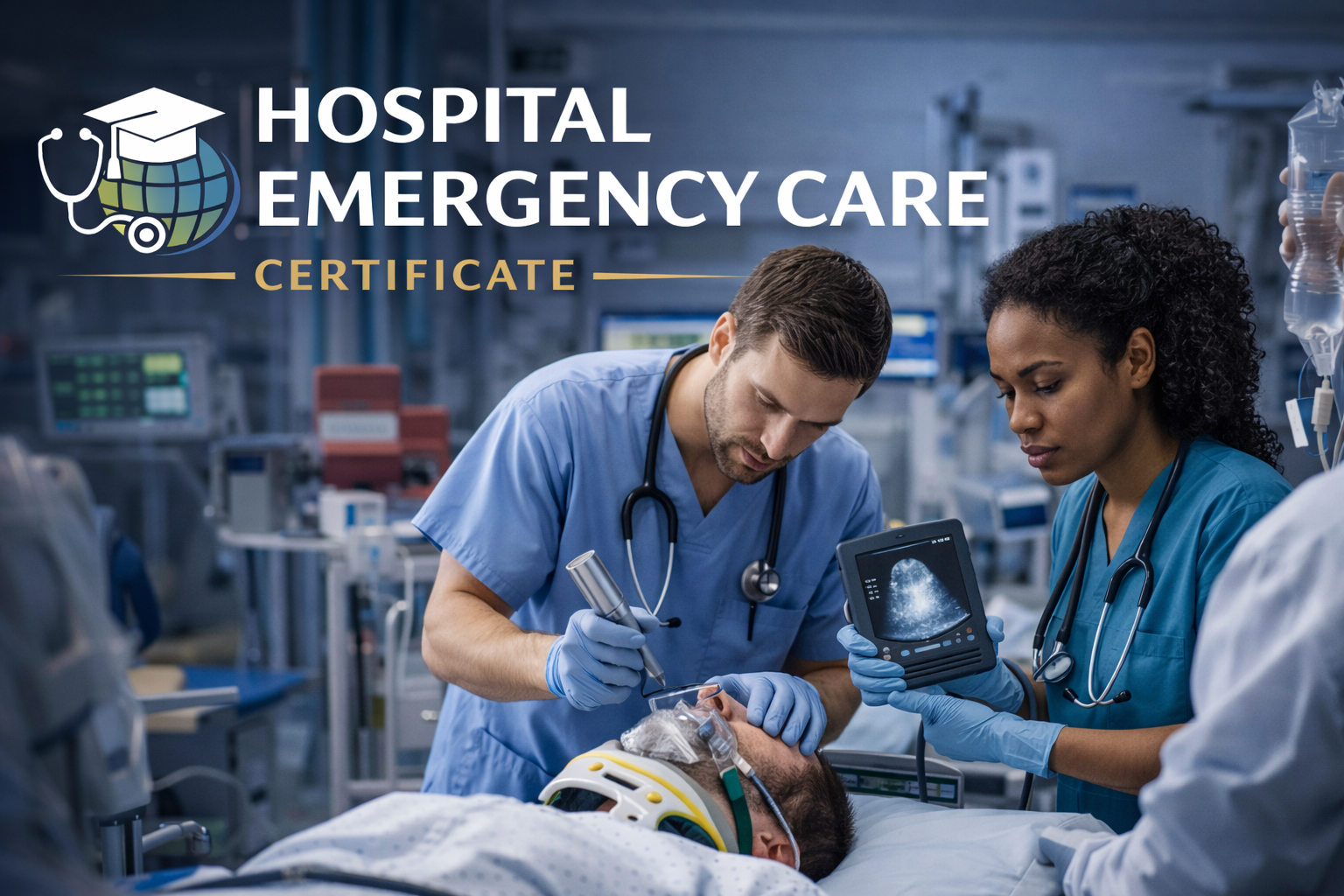
Hospital Emergency Care (HEC) Doctors
Course Description
This intensive, short-cycle clinical programme is designed to equip medical professionals with advanced competencies in the assessment, resuscitation, stabilisation, and management of critically ill and injured patients within hospital emergency departments.
Emergency medicine requires rapid clinical judgement, adherence to international protocols, and the ability to manage multiple high-acuity patients under time-critical conditions. Clinicians working in emergency settings are responsible for the immediate evaluation of patients, initiation of life-saving interventions, coordination of diagnostic investigations, and referral or admission for definitive care. The HEC Certificate addresses these demands through structured, evidence-based training grounded in international emergency and critical care standards.
The programme is delivered over 28 intensive days and focuses on the recognition and management of medical, surgical, and trauma emergencies in hospital environments. Emphasis is placed on advanced life support, trauma management, airway control, emergency ultrasonography, mass casualty response, and safe intra-hospital transfer of critically ill patients.
Teaching is delivered through a combination of formal classroom instruction, practical skills stations, and high-fidelity simulation exercises, enabling participants to translate theoretical knowledge into effective clinical performance. Simulation-based assessment and scenario-driven training ensure competence in managing both individual critical cases and complex multi-victim emergency situations.
Course Objectives
On successful completion of the Hospital Emergency Care (HEC) Certificate, participants will be able to:
- Apply a systematic and evidence-based approach to emergency patient assessment and management
- Perform rapid primary and secondary surveys in accordance with international emergency care standards
- Deliver advanced life support for adult and paediatric patients, including cardiac and respiratory emergencies
- Manage complex trauma cases, including haemorrhage control, spinal precautions, and multi-system injuries
- Demonstrate competence in advanced airway management, including difficult airway scenarios and rapid sequence intubation
- Utilise point-of-care ultrasonography to support clinical decision-making in emergency settings
- Apply international critical care and emergency protocols within hospital environments
- Coordinate and execute the safe intra-hospital transfer of critically ill patients
- Respond effectively to mass casualty incidents within hospital emergency departments
- Demonstrate clinical competence through simulation-based assessments and multidisciplinary drills
Key Clinical Training Areas
- Basic Life Support (BLS)
- Advanced Cardiac Life Support (ACLS)
- Advanced Trauma Life Support (ATLS)
- Paediatric Advanced Life Support (PALS)
- Difficult Airway Management and Rapid Sequence Intubation
- Point-of-Care Emergency Ultrasonography
- Mass Casualty Management in Hospital Settings
- International Critical Care and Emergency Protocols
- High-Fidelity Simulation and Emergency Drills
- Multi-Victim Emergency Department Scenarios
Target Audience
The Hospital Emergency Care (HEC) Certificate is designed for:
- Medical doctors working in emergency medicine, internal medicine, anaesthesia, or critical care
- Junior and senior physicians involved in the initial assessment and stabilisation of emergency patients
- Hospital-based clinicians seeking to strengthen competencies in emergency and trauma care
- Medical professionals preparing for roles in emergency departments, trauma units, or critical care services
Entry Requirements
Applicants must meet one of the following criteria:
- A medical degree (MD or equivalent) recognised by the relevant national authority
- Current or prior clinical experience in hospital-based care, emergency medicine, or acute care settings
Applicants may be required to:
- Provide evidence of medical qualification and professional registration, and/or
- Attend an admissions interview to assess suitability for intensive clinical training